
Why Nvidia Fell After a Record Quarter
Revenue beat. Earnings beat. The stock dropped anyway. Here is what the market was actually reacting to.
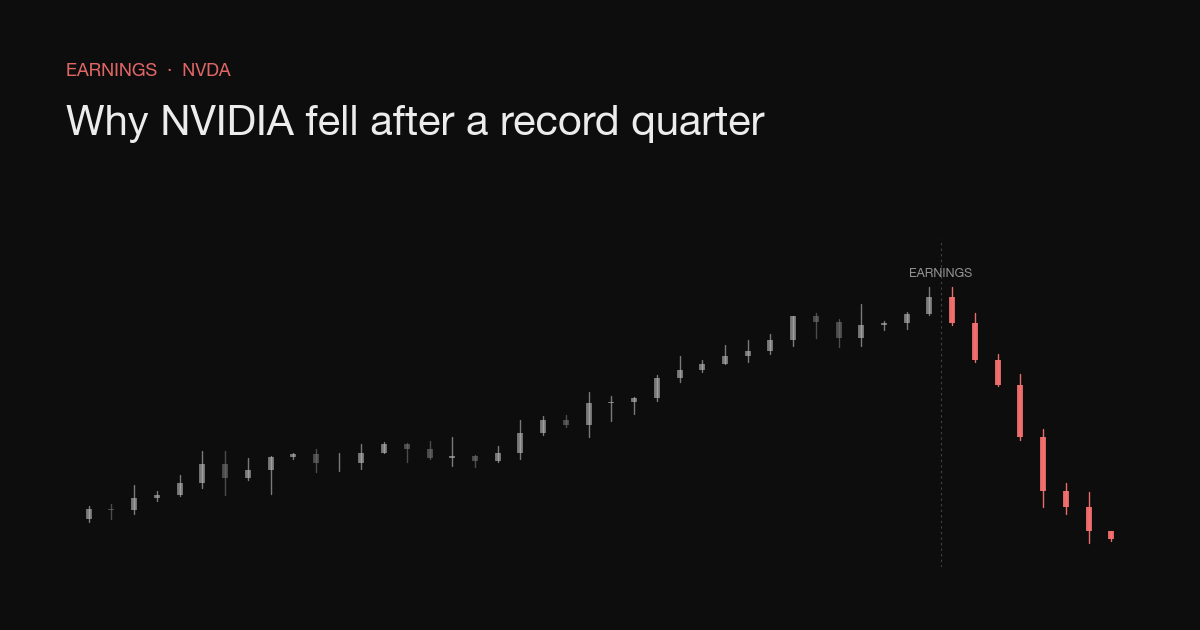
When a company beats on revenue and earnings and the stock still falls, new investors are understandably confused. Nvidia has done exactly this more than once. The lesson generalizes far beyond one chipmaker: a stock trades on expectations, not on the past quarter.
The print looked great
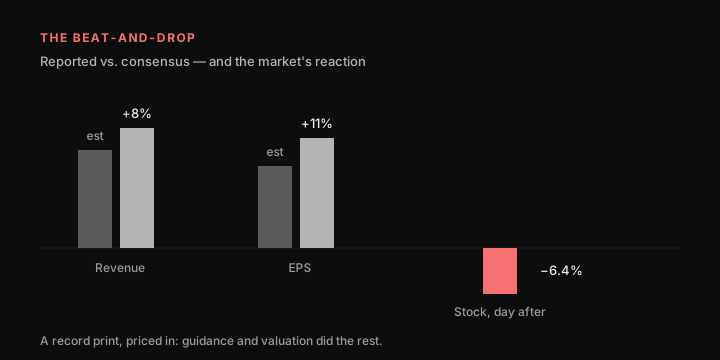
On the surface, everything was up and to the right (figures below are illustrative of a typical blow-out quarter):
| Metric | Reported | Consensus | Y/Y |
|---|---|---|---|
| Revenue | ~$26.0B | ~$24.6B | +200%+ |
| Data-center revenue | ~$22.6B | ~$21.0B | +400%+ |
| Non-GAAP gross margin | ~78.4% | ~77.7% | +1,300 bps |
| Non-GAAP EPS | ~$6.12 | ~$5.59 | +400%+ |
A clean beat across the board. So why the sell-off?
Three things the tape was really watching
- Guidance vs. the whisper. Sell-side consensus is the published bar. For momentum names there is a second, higher bar — the “whisper number” that traders have already priced in. Beating consensus while missing the whisper reads as a miss to the people who set the price.
- The rate of change. Hyper-growth stocks are valued on acceleration. When sequential growth slows — even from a spectacular base — the multiple compresses.
- Margins at the peak. A guide to flat-to-down gross margin, after several quarters of expansion, signals the easy pricing power may be behind the company.
The bar a great stock has to clear is not the analyst estimate printed in the headline. It is whatever the share price already assumes — and that bar is usually higher.
How to pressure-test a beat-and-drop yourself
- Compare guidance to the next-quarter consensus, not the quarter just reported.
- Watch sequential (quarter-over-quarter) growth, not just year-over-year.
- Read the margin commentary in the call — that is where management hedges.
- Check how far the stock ran into the print. A name up 25% in a month has priced in a lot of good news.
None of this requires a Bloomberg terminal — it requires reading the guidance and the call transcript with the right questions in mind.
Sources
- Company quarterly press release and CFO commentary.
- Earnings-call transcript (prepared remarks + Q&A).
- Consensus estimates as published by sell-side aggregators.